
How it works
You can set your 401k on a set it and forget it mode. In good years, you might win big. But in bad years, you may give up previous gains unnecessarily. Using decades of proven academic research, we developed a model that provides an easy to use monthly strategy to guide your 401k investment choices with lower risk than just leaving the money in an index fund.
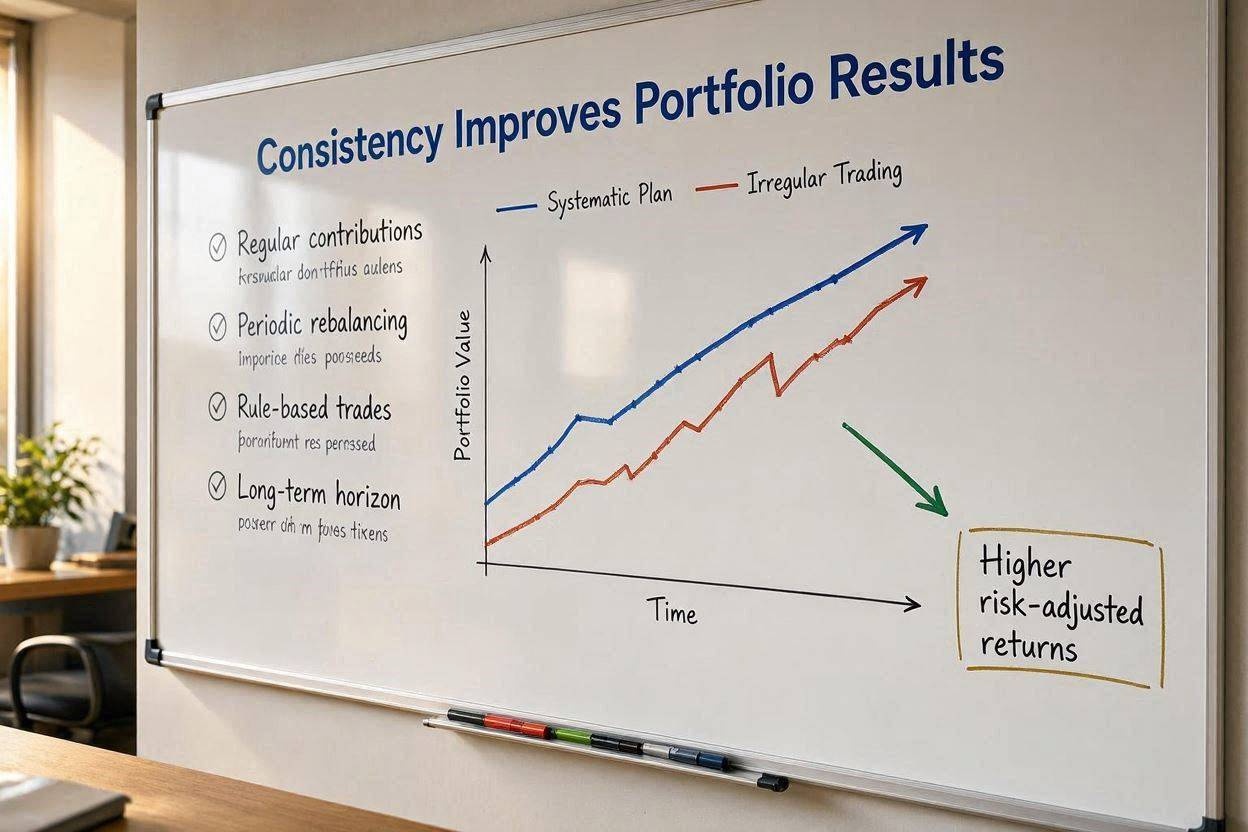
The foundation of our approach
For 401k participants, one of the biggest questions is “What should I invest in”? In the past the default option was a money market fund, earning interest that was below the inflation rate. Target date funds have become the default option. But they have a flaw – as people live longer, they need their money to work longer. Target date funds automatically shift into bonds as you age. But bonds are no longer the risk buffer they once were. When long term interest rates trend up, bonds lose value. You also lose out to potential gains in the stock market during strong uptrends.
Momentum is your friend
Decades of academic research — from Jegadeesh & Titman to Asness, Moskowitz & Pedersen — document that assets with strong relative performance over the past 3–12 months tend to continue outperforming over the next 1–6 months. Our model measures momentum monthly and tilts allocations accordingly.
Trend Following for Drawdown Control
401k investors are in it for the long term, and that’s why being on the right side of the trend for the majority of the time is important. Using research pioneered by Mabine Faber, we use trend filters to cut equity exposure during sustained downtrends — managing drawdowns systematically. It’s why we only had a max 14% yearly drawdown versus 50% for the S&P 500.
We reduce risk when it gets stormy
Market volatility is like the bodies pulse. When things are running smooth, the pulse is normal. When volatility is elevated that can signal something is wrong. We adjust risk by reducing market exposure when things get volatile.
Monthly Rebalance Cadence
Rebalancing too frequently generates excess trading; too infrequently lets drift erode the model’s signal. Monthly cadence balances responsiveness with stability — and maps cleanly to the rebalance windows most 401(k) plans allow.
Our strategy vs buy and hold
If you were close to retirement at the beginning of 2000, you would had to endure a brutal ~50% market drawdown, and it took 13 years for it to recover back to its former high. Our method would have limited the downside to less than 14% with essentially the same long term return. In 2000, the market was severely overvalued, and we find ourselves in the same position now. We can’t predict or avoid the next major market downturn, but we can minimize risk if and when it does come.
Proven Performance

Begin Your Journey to Financial Security Now
Unlock expert 401k investment strategies designed to grow your retirement savings. Subscribe to receive monthly tailored recommendations and maximize your long-term gains with our proven analytical system.